Forskningen i FLYWELL
Fagartikler produsert i FLYWELL prosjektet
This article problematises the representation of air travel in the three most widely read Norwegian newspapers and news platforms: VG , NRK and Dagbladet . While research recognises air travel as the most carbon-intensive activity that an individual can undertake, Norwegians are among the most frequently flying Europeans. This article explores how the main discourses on air travel have evolved and shows that the Norwegian press has maintained the image of air travel as a common, carefree, pleasure-related practice. The discourse analysis of 1938 units published from 1993 to 2023 identified two opposing discourses on air travel: (1) carefree air travel ; and (2) call for climate action , where the carefree air travel discourse has a dominant role throughout the analysed period of 30 years. The theoretical framework departs from Bourdieu’s theory of practice and conceptualises tourism as a field where media discourse plays a significant role in shaping perspectives on air travel, consumption (of places) and vacationing. Focusing on the meanings and contexts in which these social practices are presented, this article provides insights into the factors structuring the social reality of air travel and conceptualises hyper(aero)mobility as symbolic capital.
Michał Czepkiewicz, Giulio Mattioli, Filip Schmidt, Elias Willberg, Lena Kilian (+ 11 andre)
Recently developed frameworks that explicitly define boundaries of sustainability, such as “a safe and just space” or “consumption corridors,” are key for achieving good lives for all within ecological limits and have been explored in multiple influential studies. However, these “corridor frameworks” have rarely been explicitly applied to mobility and transport, and there is a need for more work in this direction. In this article, we provide an overview of the corridor frameworks and their links to four main strains of mobility and transport literature: sustainable transport, transport poverty, accessibility, and tourism and long-distance travel. The literature traditions have meaningful links to the corridor frameworks, but their approaches to social and ecological justice are largely disparate and disconnected. Existing studies rarely consider explicit ecological ceilings, and when ecological impacts are considered, the focus is usually on efficiency or relative improvements. Transport poverty and accessibility literature provide a meaningful contribution to defining social floors, but they largely neglect ecological ceilings and consumption maxima. Considerations of floors and ceilings are rarely explicit or are based on unquestioned assumptions of necessity and excess. Explicit ecological ceilings and social floors in mobility have been defined at national or global scales, but there is a need for more work on locally-specific thresholds that are distributively and procedurally just. We highlight the need to more comprehensively apply the corridor framework to transportation research and suggest a research agenda with seven main directions.
Max Koch, Monica Guillen-Royo, Emil Dæhlin, Jakob Utgård, Borgar Aamaas
Globalization and commodification trends in football negatively impact the climate in terms of greenhouse gas emissions from leagues and international tournaments. a significant share of these emissions stem from the flying of teams, staff and fans. Using Norway as a case study, we ask what a national football federation is doing and could be doing to reduce its ecological footprint from air travel while maintaining the wellbeing of players and staff. We apply a combination of social practice and wellbeing theories and the avoid–Shift–improve (aSi) scheme to identify and understand the material, socio-cultural and normative elements of current travel practices and to outline potential alternatives and more sustainable ones. empirically, we triangulated qualitative data from semi-structured interviews with senior representatives of the Norwegian Football association (NFF) and a document analysis of the NFF’s travel policy with quantitative calculations of the distances travelled for all historical games for both senior national teams, and in greater detail, the greenhouse gas emissions from matches played in 2024. We find that NFF and players are in many ways locked in flight-intensive practices and correspondingly high levels of emissions, including the use of charters, half-empty planes, private jets and business class travel. While some potential reforms for the reduction of football-related flights, such as players travelling to foreign destinations directly or via digital tools for team meetings and tournament draws, may be realized immediately, others, such as concentrating international windows and tournaments in specific locations, would require changes in european and global governance systems.
Monica Guillen-Royo, Francis Munier
The economics of happiness demonstrates that social relationships are a significant source of subjective well-being. Drawing notably on the concept of defensive growth, social relationships also appear to be more environmentally friendly. Consequently, this article aims to explore the theoretical and empirical foundations of a green and cordial economy through the lens of the philosophical concept of recognition, using the French "Climate and Resilience" Act as a case study.
Flight-intensive practices and wellbeing: current evidence and future research
Monica Guillen-Royo, Kimberly A Nicholas, Tanja Ellingsen, Max Koch, Tom Erik Julsrud
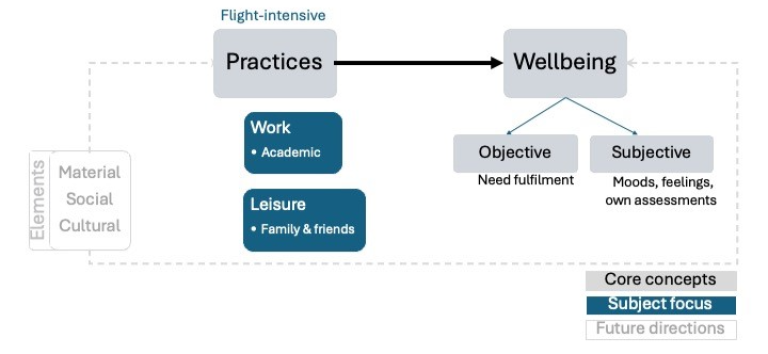
This article draws on social practice theory and wellbeing perspectives to outline a research framework for the study of flight-intensive practices. The framework is then used to discuss, through a non-systematic review, the social science air travel literature and to propose avenues for future research. We study both the work and leisure domains, with sub-cases for travel in academia and visiting family and friends. We find insights of a complex relationship between flight-intensive practices and wellbeing. On one hand, currently flight-intensive practices are linked to human need fulfilment, particularly in the family and social domains. Leisure-related air travel often enhances subjective wellbeing, as it contributes to positive moods and life satisfaction, but may not be sustained in the long term. On the other hand, flying, particularly frequent flying, hinders wellbeing by increasing levels of stress and health-related issues, and by straining work/life balance. Overall, the study suggests that policies to reduce the demand for air travel may not significantly compromise wellbeing if accompanied by infrastructural and sociocultural changes that support specific groups to still meet their needs for relatedness, participation, or understanding through low carbon transport, videoconferencing, or reducing the total amount of travel. We identify avenues for future research, both to consolidate our understanding of the practice elements that will support a shift away from flight-intensive practices, and to understand their direct effects on wellbeing.
Monica Guillen-Royo, Anders Rhiger Hansen
The two authors have chosen to write this review in the first person plural because it is the result of a dialogue about their personal understanding of the book, drawing on their respective disciplinary backgrounds. Mònica is a social scientist researching wellbeing and consumption, drawing on economics, social psychology, sociology and development studies. Mònica wrote her book Sustainability and Wellbeing: Human Scale Development in Practice in parallel with Harold Wilhite’s writing of the subject of this review. They shared chapters to read during the process while both worked at the Center for Development and the Environment (SUM) in Oslo. Anders is a sociologist researching energy practices. By combining the traits from Pierre Bourdieu’s theory of practice with newer accounts of social practice theory, Harold Wilhite’s work provided inspiration to Anders to relate these theories to energy consumption and habits, for example to conceptualise and investigate the embodiment of energy practices.
Flight intensive practices and wellbeing
Da vi startet forskningsprosjektet vårt, innså vi at litteraturen om flyreiser manglet en systematisk undersøkelse av forholdet mellom flyreiser og livskvalitet – enten i form av lykke eller i form av menneskelige behov. Derfor gjennomførte vi en (ikke-uttømmende) litteraturgjennomgang og skrev en artikkel som oppsummerer vår forståelse av litteraturen som direkte eller indirekte kobler livskvalitet med flyreiser knyttet til jobb, fritid og besøk hos familie og venner. Denne artikkelen ble publisert i tidsskriftet Consumption and Society.
Kimberly Nicholas, medleder for FLYWELL-referansegruppen, spilte en nøkkelrolle i den endelige skrivingen av manuskriptet. Takket være hennes bidrag har vi nå en figur som representerer vår forskningsramme. Denne figuren viser hvordan vi forstår flyreisepraksiser som formet av infrastruktur og materiell (f.eks. flyplasser, fly, tog, bestillingsplattformer) samt sosiokulturelle faktorer (fra normer og verdier til kunnskap og nettverker). Figuren representerer også hvordan disse elementene er knyttet til livskvalitet både direkte og indirekte gjennom flyintensive praksiser.
Etter å ha intervjuet over 50 personer om deres flyintensive praksiser i ANSA, NFF, NRK og FSV, skrev vi sammenfattende notater for internt bruk og formidling innen de samarbeidende organisasjonene. Notatene ga et øyeblikksbilde av dataene, som vi skal analysere i 2025. De fokuserer på ansattes og medlemmers beskrivelser av deres fly intensive praksiser, organisasjonskultur, fritidsreiser og personlige forståelser av livskvalitet. Notatene ble presentert på referansegruppemøtet i oktober 2024, hvor representanter fra de samarbeidende organisasjonene mente at de reflekterte den nåværende situasjonen. Noen ansatte som mottok notatene har også bekreftet dette inntrykket.